Connecting Europe Days: Innovation is no longer the challenge. Scaling it is.
12.10.2026
Every two years, the European Commission brings together policymakers, transport operators, industry leaders and researchers at ‘Connecting Europe Days’, one of Europe’s flagship events for transport and mobility. This year’s edition provided an opportunity to reflect on how European Green Deal projects are helping airports and ports become both more sustainable and smarter.
Stargate was present throughout the event, with a booth showcasing key project achievements and learnings. Charlotte Verreydt, Stargate Project Coordinator at Brussels Airport, also took part in the panel discussion ‘Success stories in airports and ports greening and digitalisation: the Green Deal project’s, alongside representatives from the sister airport projects OLGA and TULIPS, as well as the port projects PIONEERS and MAGPIE. Together, they shared how five years of innovation funding have translated into tangible results in real operational environments.
What five years of Stargate taught us
During the discussion, Charlotte discussed a challenge shared by airports across Europe: how do you decarbonise while remaining competitive, efficient and resilient?
One of Stargate’s most valuable contributions has been its ability to distinguish between innovations that are ready for deployment today and those that remain promising but require further maturation before becoming commercially viable.
To illustrate this approach, Charlotte presented two Stargate projects that demonstrate how innovation can create both environmental and operational value.
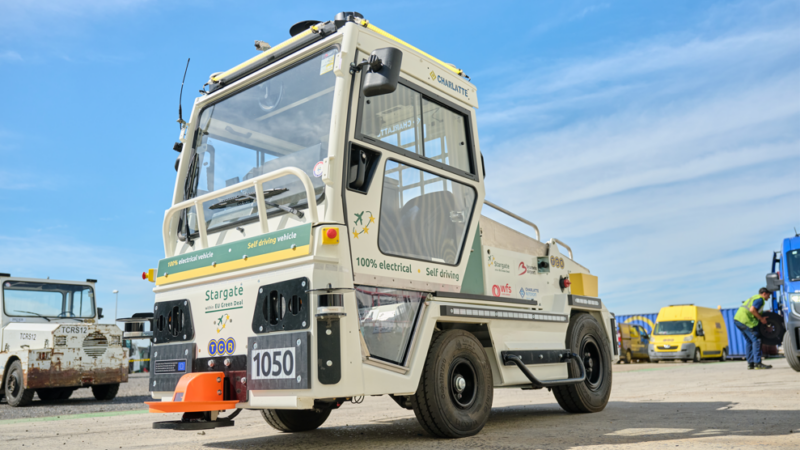
One focused on an autonomous electric cargo tow tractor used to transport dollies between warehouses and aircraft stands. Beyond reducing emissions and energy consumption, this pilot project showed how automation can take over repetitive tasks, improve working conditions and allowing employees to focus on higher-value activities. It also highlighted what is still needed before autonomous vehicles can be deployed at scale, including regulatory frameworks, digital infrastructure and operational procedure.
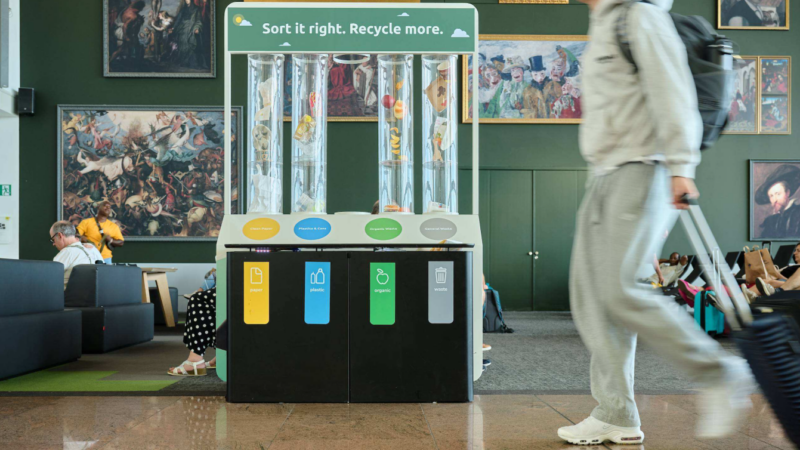
A second example focused on waste sorting in the terminal. Using AI-powered cameras and sensors, Stargate analysed more than 200,000 waste items to better understand passenger behaviour and identify contamination hotspots. The results showed that a small number of recurring items caused a large share of sorting errors. Simple measures such as adapted bin openings and improved signage delivered measurable improvements while also reducing waste management costs and increasing recycling quality. The project demonstrated how digitalisation can support sustainability while improving operational efficiency and investment decisions.
Creating the conditions for scale
The discussion also featured remarks from Ewa Oney, Deputy Head of Unit at the European Commission’s Directorate-General for Mobility and Transport (DG MOVE).
Her message was clear: Europe now needs to focus on deployment and scale-up. Technologies such as sustainable aviation fuels, airport electrification and future solutions including hydrogen require not only innovation, but also long-term regulatory certainty, funding mechanisms and investor confidence.
While public funding remains crucial, particularly during the riskiest phases of development, private investment will also play an essential role in bringing successful demonstrations to market. Ewan Oney emphasized the Commission will continue to develop both regulatory frameworks and funding instruments to support this transition.
The question is no longer whether innovation works
A common conclusion emerged across all five projects. The technologies work. The business cases are there: real-life demonstrations have proven that sustainability and competitiveness can go hand in hand.
Today, the main challenge is no longer technological feasibility. It is speed of adoption.
Five years ago, five Green Deal projects started with ambitious ideas. Today, they leave behind concrete results, valuable data, strong partnerships and practical lessons. For airports and ports looking to accelerate their own transition, the evidence is already there. There is no need to start from scratch.