What happens when a promising circular economy idea enters the busy reality of an airport?
01.10.2026
Airports are often compared to small cities. That makes them an ideal place to test circular economy solutions, but also one of the most challenging environments in which to scale them. A pilot may work in a single terminal, building or operational area. Expanding it across a whole airport ecosystem involving passengers, retailers, airlines, ground handlers and infrastructure partners is another story altogether.
This challenge was at the heart of a recent ACI EUROPE webinar, where representatives from the EU-funded TULIPS, OLGA and STARGATE projects shared their practical experiences with circular economy initiatives across European airports.
A common message emerged throughout the session: circularity is no longer a distant ambition. Regulation is increasingly setting the direction, while airports are already putting circular principles into practice. Yet, moving from an individual pilot to a solution that works at scale in a complex airport environment remains a key challenge.
STARGATE – 1,123 kg coffee grounds and 12,000 reusable cups
Representing Stargate, Jonathan Rens, Project Manager at Brussels Airport, presented three practical cases focusing on coffee grounds, reusable coffee cups and smarter waste flows.
In the coffee grounds pilot, a dedicated collection stream was created to give used coffee grounds a higher-value second life. Over three months, 1,123 kg were collected and processed into material that was ultimately used to produce 1,200 reusable travel mugs. The pilot showed the potential of closing material loops, but also the importance of logistics and economies of scale when moving beyond a test environment.
If the first pilot focused on materials, the second focused on people. A trial of reusable coffee cups in the terminal explored how passengers would respond to a more circular system. 12,000 cups were used during the two-month pilot. The pilot revealed how strongly behaviour can be influenced by small incentives. Without a deposit, only 33% of the cups were returned. Introducing a €3 deposit increased that figure to 64%. Passenger feedback was encouraging as well: 76% of respondents said they would like to use reusable cups in the future.
The trial also highlighted one of the recurring lessons of the webinar: communication is key. Passengers need to understand quickly how a system works, while airport teams and business partners need to be involved if a circular solution is to become part of daily operations.
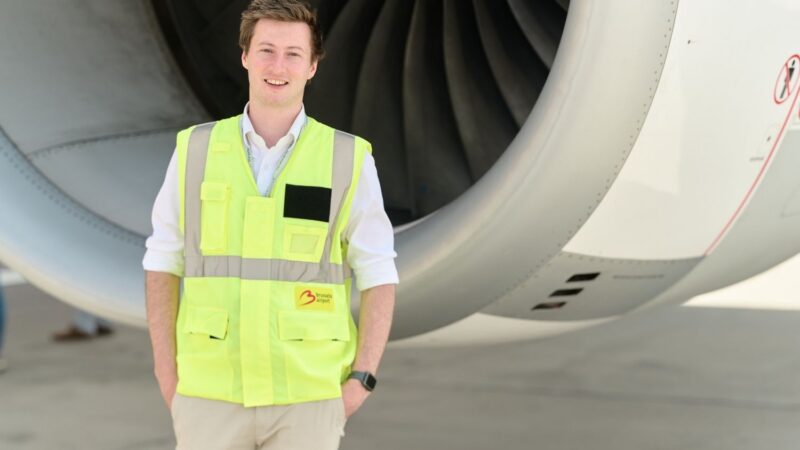
“Communication is key, both with passengers and with stakeholders across the airport community”
Jonathan Rens, Project Manager, Brussels Airport
Together, the coffee and reusable cup pilots showed that circularity is as much about people as it is about materials. Stargate’s Smart Waste Flows project added a third dimension: data. Detailed waste audits were combined with AI-supported cameras and fill-level sensors to better understand where waste originates, where sorting problems occur and how waste moves through the terminal. This made it possible to test more targeted interventions and compare their actual impact. One of the key lessons was that more technology does not automatically mean better results: in some cases, relatively simple changes proved more effective than more complex solutions, helping to identify what is truly worth scaling up.
TULIPS – From waste sorting to a second life for building materials.
One interesting finding shared by TULIPS came from Amsterdam Airport Schiphol. Intuitively, clearer signage on passenger waste bins should improve sorting behaviour. In practice, the impact proved limited. The pilot highlighted an important lesson: improving circularity requires more than influencing passenger behaviour. Prevention, cleaner back-of-house waste streams and smarter sorting solutions all have a role to play.
Another pilot at Schiphol focused on giving construction materials a second life. Materials were tagged, digitised and made available through an internal marketplace, supported by digital product passports. Over six months, more than 400 assets were reused, avoiding almost nine tonnes of CO₂ and around €50,000 in new purchases.
OLGA – Can taxiways, equipment and waste all be part of the circular economy?
OLGA demonstrated how circular thinking can be applied across very different airport activities. At Paris Charles de Gaulle, a new approach to taxiway refurbishment aimed to reduce environmental impact and future maintenance, with the pilot reporting a reduction of 16 kg of CO₂ per square metre.
At Milan Malpensa, waste streams in the airport and cargo area were mapped to identify opportunities to turn waste into secondary raw materials. Other examples presented included reusable packaging, mobile aircraft recycling and ‘Airport Market’, a platform designed to extend the life of airport equipment through resale and refurbishment.
Together, these cases underlined that circularity is not one single solution, but a combination of operational changes, partnerships, new business models and behavioural change.
From pilots to lasting change
Across TULIPS, OLGA and STARGATE, the value of testing and learning was clear. Not every intervention produced the expected result, but those insights are essential to identifying what can work at scale.
Airports may move more like tankers than speedboats: changing direction takes time, but once a clear course is set, they can move steadily forward. With regulation providing additional momentum, strong communication across the airport community and focused pilots designed with scaling in mind, circularity is increasingly moving from ambition into everyday airport operations.