The AIMS Framework – building business cases for innovative airport initiatives
18.09.2026
Interview with Floris de Haan and Walter Heijkamp
The Airport Initiatives Management and Strategy Framework (AIMS) is designed to help airports build positive value propositions for their sustainability ambitions and innovative initiatives. But how is it different from classic business model frameworks?
That’s what we’ve asked researchers Floris de Haan and Walter Heijkamp of the Erasmus Centre for Urban, Port and Transport Economics (Erasmus UPT) who developed the AIMS framework and applied it to five Stargate projects.
To get straight to the point: How does the AIMS framework differ from existing, more generic business model frameworks?
Walter: When we started working on the framework, we asked ourselves, how are we going to tackle this? We initially drew inspiration from the Business Model Canvas, a well-known framework that is widely used in business modelling. However, the interactions at an airport proved far too complex to fit into that template. An airport is an intricate web of multiple parties, each with their own incentives, who all need to work together. Moreover, the party paying for the innovative project is not always the party that benefits. We therefore had to take the perspective of all those stakeholders in order to structure our framework more effectively.
Why do you say an airport is too complex for a standard business model framework?
Walter: Traditional business models are based on a company with its own customers and suppliers, for which revenue is the primary measure of viability. At an airport, there are many more aspects to factor in: the interests of various stakeholders, infrastructural or operational constraints, required permissions and any aspect that could block the initiative later on.
Revenue is not the key driver in the AIMS framework then?
Walter: Whereas revenue is the primary motivation in classic business models, our research shows that for the Stargate innovations we examined, the type of value that is created often consists of costs that are avoided.
Floris: And it’s not only about avoided costs because there are also many effects that cannot be quantified in financial value alone.
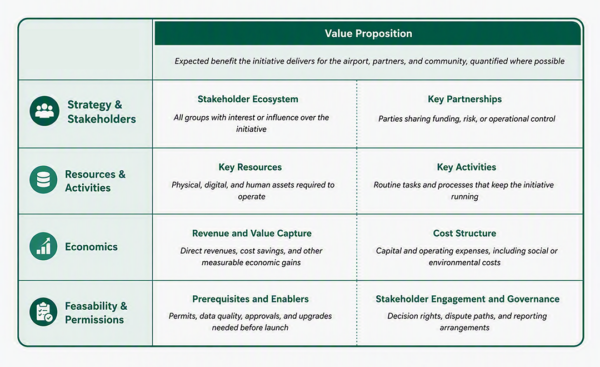
Walter: Exactly. That’s why our framework separates the two. The Revenue and Value Capture block covers revenue, avoided cost, and other economic gains while the Value Proposition block holds what cannot be easily monetized, such as sustainability or societal value.
Could you give an example?
Floris: AIMS includes avoided costs, who captures value, who pays and who carries the risk. We filled in the framework for five Stargate initiatives. The Digital Twin, Smart Charging, the Solar Energy Community, CargoRun and Sustainable Taxiing. For the Digital Twin and Smart Charging, the party paying is also the party benefiting, mainly through avoided costs. In the other three projects, the party bearing the cost is not the party that benefits.
Walter: The Sustainable Taxi project is a good example to make that clear. A towing vehicle, the TaxiBot, connects to the nose landing gear of a narrow-body aircraft and moves it from the stand to the runway with engines shut down until the final minutes before take-off. Taxiing and ground movements account for a meaningful share of airport carbon emissions and are a significant source of ultrafine particles. The framework identifies four potential value streams here. Fuel and emissions savings would be captured by the airline. Reduced ultrafine particle and noise levels on the apron would benefit ground staff and surrounding communities. The airport would capture positioning towards permits and accreditation. And there is an effect on relations with neighbouring municipalities.
Floris: However, in the proof of concept at Brussels Airport, the initiative ran into infrastructure constraints: there were only two places where the TaxiBot could be uncoupled, and the taxi times were too short to yield significant environmental benefits or fuel savings.
You interviewed partners both within and outside the Stargate consortium to establish the framework. Did anything come to light in the process that came as a surprise?
Walter: In total we interviewed 54 industry experts and from what we have gathered, collaboration between the various parties involved in a pilot project went smoothly – even better than I had expected. In the five projects we selected, we can also say that the technology does what it’s supposed to do. Context, in particular, often proved to be far more important in the proofs of concept. As Floris mentioned, the taxi times being too short during the tests with the TaxiBot at Brussels Airport proved decisive. That is perhaps the major key takeaway for us: always look very carefully at your own, specific context before adopting initiatives.
Floris: If I may add to that: different airports have different priorities and contexts. Take the TaxiBot at Schiphol. While reducing emissions was an important benefit, the project also addressed improving working conditions for apron staff. At another airport, the primary drivers may be different. Our framework is designed to accommodate these varying goals and help stakeholders build a business case that reflects their specific needs.
In summary, can we say that the AIMS framework is a sort of checkbox list that you complete before starting a project?
Floris: Not quite. A checklist assumes you already know what matters and that you are done once everything is ticked. AIMS gives you the questions, not the answers. Who pays, who benefits, who carries the risk, and what could block the initiative later on. Those answers differ per airport and they change as a project develops. At the General Assembly in Budapest we tested that with a deliberately simple case. Suppose an airport stops selling water in plastic bottles to cut waste. Does everyone bring their own bottle? Do you install refill points across the terminal? Who cleans them, and what does that cost? Within half an hour the group had mapped a web of parties, costs and dependencies behind one apparently small decision. The framework does not tell you whether to go ahead. It tells you what you need to know before you can decide.
Earlier this year, we used the AIMS framework during a client workshop, developing an airport decarbonisation plan. Together with airport stakeholders, including the airport, airlines, ground handlers and taxi operators, we explored how to turn measures such as SAF adoption and taxi fleet electrification into viable business cases. The framework helped us tailor the discussions and translate ideas into concrete actions.
Lise Gascard – To70 Aviation Consultancy