Smart Waste Flows
16.09.2026
Circularity at an international airport is a real challenge, especially with passengers from all over the world, each with their own sorting habits. Sorting rules differ from one country to another and what is considered as recyclable waste in one country, may end up as residual waste elsewhere.
So what can airports undertake to nudge people into sorting their waste correctly to avoid contamination of recyclable waste streams? How can they make the system intuitive for people of every nationality? And what should they focus on? That’s what Stargate tested at Brussels Airport.
First we started by establishing a baseline of reality. To that end 160 waste islands, or 480 individual bins, were monitored. We manually opened and inspected 266 bags, combing through 298 kg of waste to identify the most common sorting errors and the locations where they were the most likely to occur.
Most common errors: coffee cups, coloured bags, loose paper and organic waste
The most common sorting errors are made with coffee cups, coloured bags, loose paper and food waste. To help people sort their waste properly, we tested various solutions ranging from improved signage and new lid designs to dedicated bins.
For the tests, 24 waste islands were selected, spread over Pier A. Cameras installed inside the bins took a photo every 5 minutes that then analysed with AI to identify the kind of waste. Moreover, the bins of 8 waste islands were equipped with fill level sensors, as overflowing bins could affect the outcome.
Universally recognised: the apple core
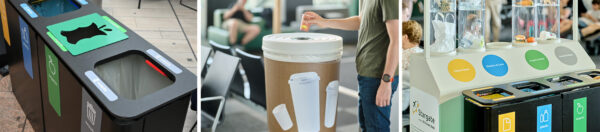
- Apple core lid
Organic waste ends up in the residual waste bin far too often. The test using a bin with an apple core lid, proved to be the most effective. It decreased the contamination rate of the other waste streams by more than 30%.
- Dedicated coffee cup bin
Single-use coffee cups belong in the residual waste bin, not in the paper & cardboard or PMD bins. Installing a dedicated coffee cup bin – shaped like a coffee cup – next to the other bins, significantly improved the sorting rate of single-use coffee cups.
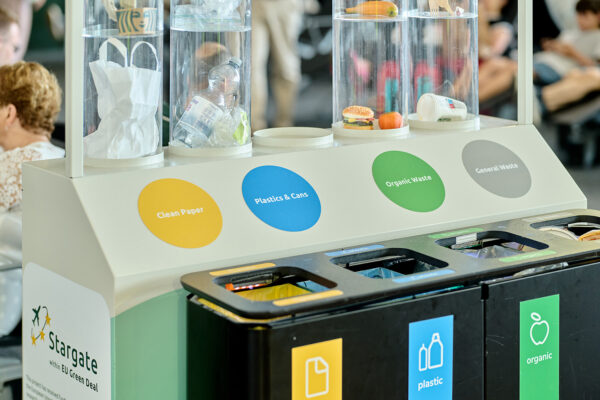
- 3D info display
The 3D info above the waste bins did not significantly reduce sorting errors during the trial period.